
How to Choose a Custom Jeans Factory? First Distinguish Capability Statements from Order Conditions
A factory selection guide for brands, wholesalers, and buyers. Rather than comparing factory size or quality adjectives, this article distinguishes item by item between "factory capability statements" and "order confirmation conditions": what premises underlie production capacity statistics, sampling lead times, bulk delivery timelines, and in-stock shipping. Suitable for sourcing professionals evaluating custom denim manufacturers who need to judge the boundaries of what a supplier claims.
When selecting a custom factory, production capacity, sampling, and delivery timelines are all conditions that must be verified per order and cannot be treated as general commitments; you should first ask the supplier to separately explain factory capability statements and specific order confirmation milestones.
In this article
"Monthly capacity of 300,000 pieces" vs. "can my batch fit into your schedule"3-day sampling, 30-day bulk delivery, same-day shipping for stock—each has its own preconditionsShipping and delivery are two different thingsCustom development references are not stock inventoryIs MOQ calculated per style, per color, or per sizeWhat a quote includes and what it doesn'tAfter sample approval, can the factory still make changes on its own?Checklist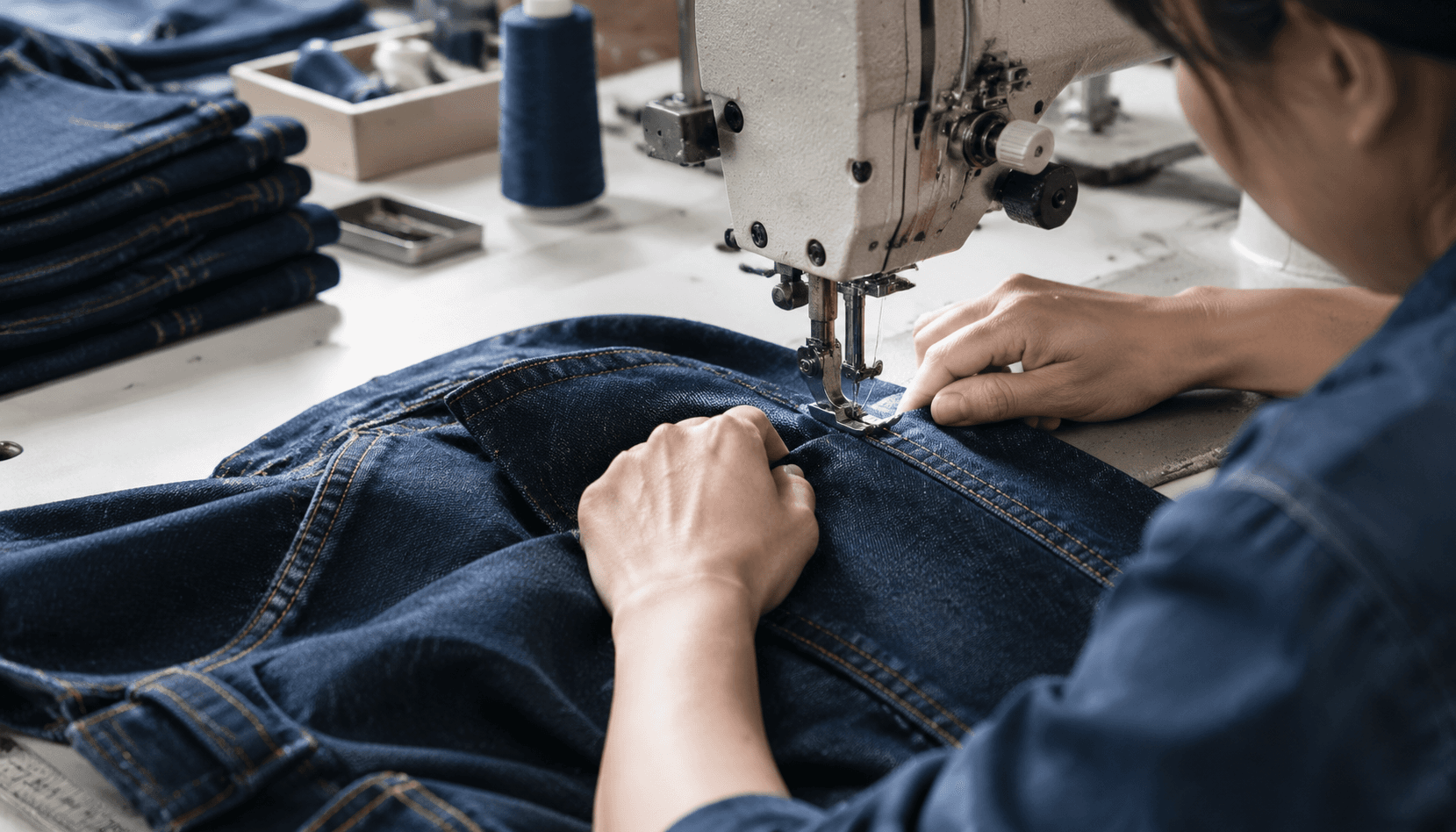
When choosing a custom denim manufacturer, the easiest trap to fall into—beyond whether they actually have a workshop—is treating their stated capabilities as if they were your order terms.
Workshop photos and equipment videos can show that a certain stage is in production, but they cannot answer "when will my batch ship." Likewise, when a manager says "monthly capacity of 300,000 pieces," that is a figure whose scope and current scheduling still need to be confirmed—it is not a promise that holds for every style at every time.
Below, we break down several commonly confused claims one by one.
"Monthly capacity of 300,000 pieces" vs. "can my batch fit into your schedule"
The capacity figure has a source: the project manager provided a factory capacity figure of 300,000 pieces, corresponding to monthly capacity in prior communications. But before using a monthly figure formally with customers, the sales team should reconfirm the statistical scope and currently available scheduling.
What needs to be asked: What scope does this figure cover—sewing only or the full process? Is there remaining capacity in the current schedule? Which processes does your style involve, and are they all completed in the same facility?
A common mistake buyers make is converting a capacity figure directly into "my order is fine." Capacity is a reference for the upper limit of capability; scheduling is what actually determines order terms.
3-day sampling, 30-day bulk delivery, same-day shipping for stock—each has its own preconditions
The manager's stated terms are: 3 days for sampling, bulk delivery within 30 days depending on order volume, and same-day shipping for in-stock items. These three cannot be used interchangeably.
3-day sampling requires that materials, fabrics, and processes are all ready. If the fabric needs separate confirmation or the wash effect requires repeated adjustments, 3 days is only the starting point of the process—not the total time from sending a message to receiving a sample garment.
30-day bulk delivery depends on order volume. Different volumes mean different scheduling; the more complex the wash, trims, and packaging involved, the less room there is to compress.
Same-day shipping for stock items depends on actual inventory and outbound conditions. A product page being listed does not equal in-stock availability—specific sizes and quantities should be confirmed against the current ordering window and with the sales team.
All three share one common question: from which confirmation point does the lead time start counting? Is it the sample approval date, the order confirmation date, or the date fabric arrives at the factory? This must be written into the order—otherwise "30 days" has no starting line.
Shipping and delivery are two different things
Factory completion, carrier pickup, international transit, and customs clearance are separate milestones. Ship date does not equal delivery date. Freight costs, shipping method, duties, customs responsibilities, and trade terms must be confirmed in the quote or order—when unknown, do not default to DDP or any specific carrier.
Providing the destination country, postal code, estimated quantity, and desired delivery date allows the sales team to calculate a logistics plan. This is a separate track from factory capacity and cannot be covered by a single number.
Custom development references are not stock inventory
The custom product gallery includes front and back model shots, flat-lay front and back views, and detail shots, used to communicate style structure and design direction. These reference images do not prove that physical samples exist, that stock is available, that real customers exist, or that mass production capability is in place—nor can they be used to derive accurate composition or process parameters.
When customers ask about the final product result, they should be guided to confirm sample garments, colors, sizes, and process records. Image displays cannot replace formal specifications and sample confirmation.
A good starting question: Are you sourcing existing styles, or do you need development based on your own brand requirements? For the former, see stock denim sourcing—verify sizes, quantities, inventory, and shipping arrangements style by style. For the latter, move into custom denim development and private label services to discuss fit, fabric, wash, and branding details.
Is MOQ calculated per style, per color, or per size
Some custom development references on the website indicate a 30-piece MOQ per style; MOQs for other custom styles still need to be confirmed based on the specific plan. 30 pieces is not a universal commitment for all styles, fabrics, or colors.
For stock items, the MOQ shown on the current product page and ordering window applies; some items support a 1-piece minimum with mixed sizes in the same style. Verify whether the MOQ rule is calculated per style, per color, or per size—do not assume quantities from different styles can be combined by default.
For smaller quantities, you can first discuss stock trial sales or sample development, then verify whether custom production can be arranged.
What a quote includes and what it doesn't
Quote discussions need to account for style, quantity, fabric, wash, trims, branding customization, packaging, and delivery requirements. The range prices and tiered prices on stock pages are not the lowest price applicable to any quantity—they should be verified against the combined quantity for the same style and current specifications. Custom products are quoted based on requirements and do not follow stock pricing.
When comparing quotes, confirm whether sample fees, trims, packaging, shipping, duties, and other services are included. Without confirmation in a quotation, do not assume free shipping, duty-inclusive pricing, or free sampling.
To enable accurate quoting, provide reference styles, estimated quantities, size breakdowns, and destination country first.
After sample approval, can the factory still make changes on its own?
Sample approval means both parties have agreed on the production reference—it does not mean the factory can decide unconfirmed details on its own. After receiving the sample, it's best to consolidate feedback on fit, measurements, fabric hand feel, color and wash, stitching, trims, and label placement in one go, annotating areas with photos and stating the desired result.
Distinguish between must-change items and acceptable variations to avoid conflicting verbal feedback across multiple rounds. Keep version numbers and confirmation records for each revision round; when materials or structure change, recheck costs and timelines at the same time.
Checklist
- Capacity scope: statistical range, current scheduling, processes involved
- Sampling: whether materials are ready, whether fabrics need separate confirmation, from which date the days are counted
- Bulk lead time: order volume, wash and trim complexity, starting point for counting
- Stock: actual inventory, outbound conditions, sizes and quantities
- MOQ: calculated per style, per color, or per size
- Quote: what is included, what is not
- Samples: version numbers, confirmation records, whether costs and timelines are rechecked after changes
When choosing a factory, record "factory capability claims" and "terms for your specific order" in two separate columns. For every capacity figure, timeline, and MOQ the other party states, ask about the applicable preconditions one by one—only what can be written into the order goes into the contract. Getting to this level of verification is more useful than watching a few more workshop videos.