
How to Choose a Custom Jeans Factory? Start by Checking Whether Denim Work Pants Pockets and Craftsmanship Match
For brands and buyers developing denim work pants: when choosing a custom factory, pocket construction, pocket bag materials, and bartack and other craftsmanship directly affect quoting and sample performance. This article lays out a checklist sequence from pocket craftsmanship to quote breakdown to sample confirmation, helping you put verifiable materials first when comparing factories, rather than comparing a total price first.
When choosing a factory, first see whether it can replicate your work pants pocket construction; quotes should be broken down to pocket craftsmanship and trims, not just compared by total price.
In this article
Confirm the pocket structure first, then discuss whether the factory can make itCraftsmanship specifications need to be broken down into specific operationsQuotes need to be broken down to the pocket and trims levelUse samples to confirm actual pocket performancePrepare complete information so factory responses are comparable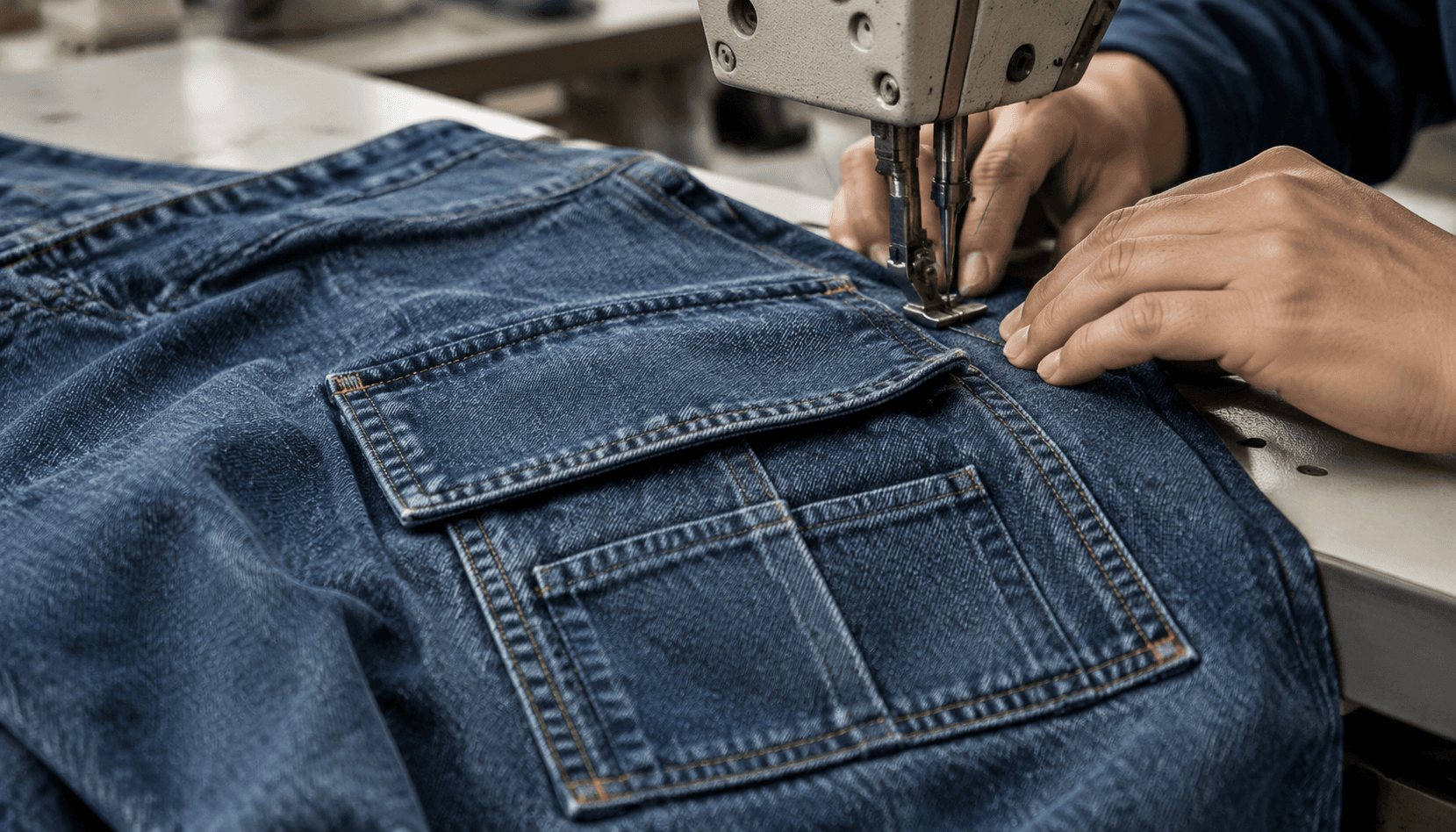
Cargo pant pockets are often more complex than a standard five-pocket style: side patch pockets, flap pockets, three-dimensional pockets, and pocket-within-a-pocket constructions. When the structure changes, so do materials, operations, and pricing. When choosing a custom denim manufacturer, it is more effective to write pocket and craftsmanship requirements into a checkable list before discussing price, rather than sending a reference image and asking "can you make this?"
Confirm the pocket structure first, then discuss whether the factory can make it
Cargo pant pockets are not a single component. Taking the common side patch pocket as an example, you need to confirm whether the pocket shape is flat or three-dimensional, whether there is a flap, whether the flap is decorative or functional, whether the pocket opening has a pocket lip or zipper, and whether the pocket bag uses self fabric or lining. These decisions determine the number of cut pieces and the sewing sequence, and also affect whether the factory needs to adjust existing templates.
If the reference style has a pocket-within-a-pocket or tool pocket, it is advisable to mark each pocket's position, dimensions, and function separately in the inquiry, rather than writing "cargo pockets" generically. The same reference image may be interpreted as different structures by different factories, and quotes will naturally not be comparable.
Craftsmanship specifications need to be broken down into specific operations
Pocket-related craftsmanship items include: whether bar tacks are applied at the pocket opening, bar tack position and quantity, whether pocket corners are reinforced, whether the flap has interlining, stitch width and stitch density requirements, and whether pocket bag edges are bound or serged. Some of these operations affect appearance, others affect wearing durability, but all consume labor time.
When comparing factories, you can ask them to respond item by item to the same craftsmanship checklist with "do / don't do / separately charged." For example, with bar tacks, some factories by default apply one at each end of the pocket opening, while others apply only one or follow customer-specified positions. When specifications differ, unit price differences may come from the number of operations, not from one factory being more expensive or cheaper.
Fabric also affects craftsmanship performance. Cargo pants commonly use heavier or firmer denim. Heavy fabric is harder to press flat at flaps and three-dimensional pocket corners, so you need to confirm whether the factory has sewing experience with the corresponding weight. Fabric composition, weight, and stretch should be based on confirmed fabric data or sample records, not judged from a reference image.
Quotes need to be broken down to the pocket and trims level
When you receive a quote, it is advisable to break the total price into several checkable parts: fabric, wash, structural operations such as pockets, trims, brand labels, packaging, and sample fees. For styles with complex pocket structures or many operations, this portion will increase noticeably.
Trims also need to be confirmed item by item. Cargo pant pockets may involve buttons, rivets, zippers, webbing, or hook-and-loop fasteners. The specifications, colors, quantities, and whether these trims are included in the quote need to be clearly stated. Brand labels such as main labels, care labels, leather patches, and hang tags are a separate category of customization items and may have independent quantity, cost, and lead time requirements. They should not be assumed to be included in the pocket operation quote.
When comparing different factories, first check whether the specifications behind the quotes are consistent. For the same cargo pant, if Factory A quotes based on a flat patch pocket with flap and Factory B quotes based on a three-dimensional pocket with pocket-within-a-pocket, placing the two numbers side by side is meaningless. Quote communication should be based on style, quantity, fabric, wash, trims, brand customization, packaging, and delivery requirements, with the confirmed quote sheet as the final reference.
Use samples to confirm actual pocket performance
After the pocket structure is confirmed, the sampling stage begins. When you receive the sample, it is advisable to check each pocket item by item: whether pocket positions are left-right symmetrical, whether the pocket opening lies flat, whether the flap opens and closes smoothly, whether bar tack positions match what was confirmed, whether topstitching is straight, and whether pocket bag edge treatment meets requirements. Marking areas with photos and writing down the target effect is easier to reproduce than verbal descriptions.
Sample approval means both parties have established the production reference, but it does not mean unconfirmed details can be decided by the factory on its own. Keep version numbers and confirmation records for each round of revisions. When pocket structure or material changes are involved, review costs and timing at the same time.
If you are looking at both available styles and custom development paths, first clarify whether you are purchasing existing styles or developing according to brand requirements. Purchasing available styles is subject to the sizes, quantities, and inventory shown in the current ordering window; custom development references show design direction and do not mean there is ready-to-ship inventory. For related processes, refer to custom denim development and private label services.
Prepare complete information so factory responses are comparable
For a first inquiry, send the reference style number or link, pocket structure description, target market, estimated quantity per style, color and size breakdown, fabric or hand feel requirements, wash effect, brand label and packaging requirements, target lead time, and destination country together. If information is incomplete, you can first send a reference image and explain the pocket details you most want to keep or adjust.
Factory capacity, sampling time, and lead time specifications need to be confirmed based on the specific order and cannot be directly applied to all styles. Sampling requires checking information, materials, and craftsmanship; bulk production requires checking volume and scheduling. Shipping does not equal arrival; transit and customs clearance time are calculated separately.
At this stage, it is advisable to first organize a cargo pant pocket craftsmanship checklist, writing out each pocket's structure, dimensions, operations, and trim requirements item by item, then send it to candidate factories for responses based on the same checklist. This checklist is the basis for subsequent quotes and sample verification.