
Denim Dress Sample Development: First Clarify How Your Style Differs from the Reference
The starting point of denim dress sample development is not fabric selection, but aligning the reference style with the target style item by item. This article compares two paths—directly carrying over existing reference style specifications versus adjusting according to brand requirements—and explains the conditions that need to be confirmed under four dimensions: fabric composition, wash effect, fit and measurements, and branded trims. It helps brands and buyers judge whether current materials are sufficient to move into sampling, and which information must be completed first.
Before sample development, align the differences between the reference style and the target style first. A change in any one of the four items—fabric, wash, fit, or trims—may require re-confirming the sample rather than directly carrying over existing specifications.
In this article
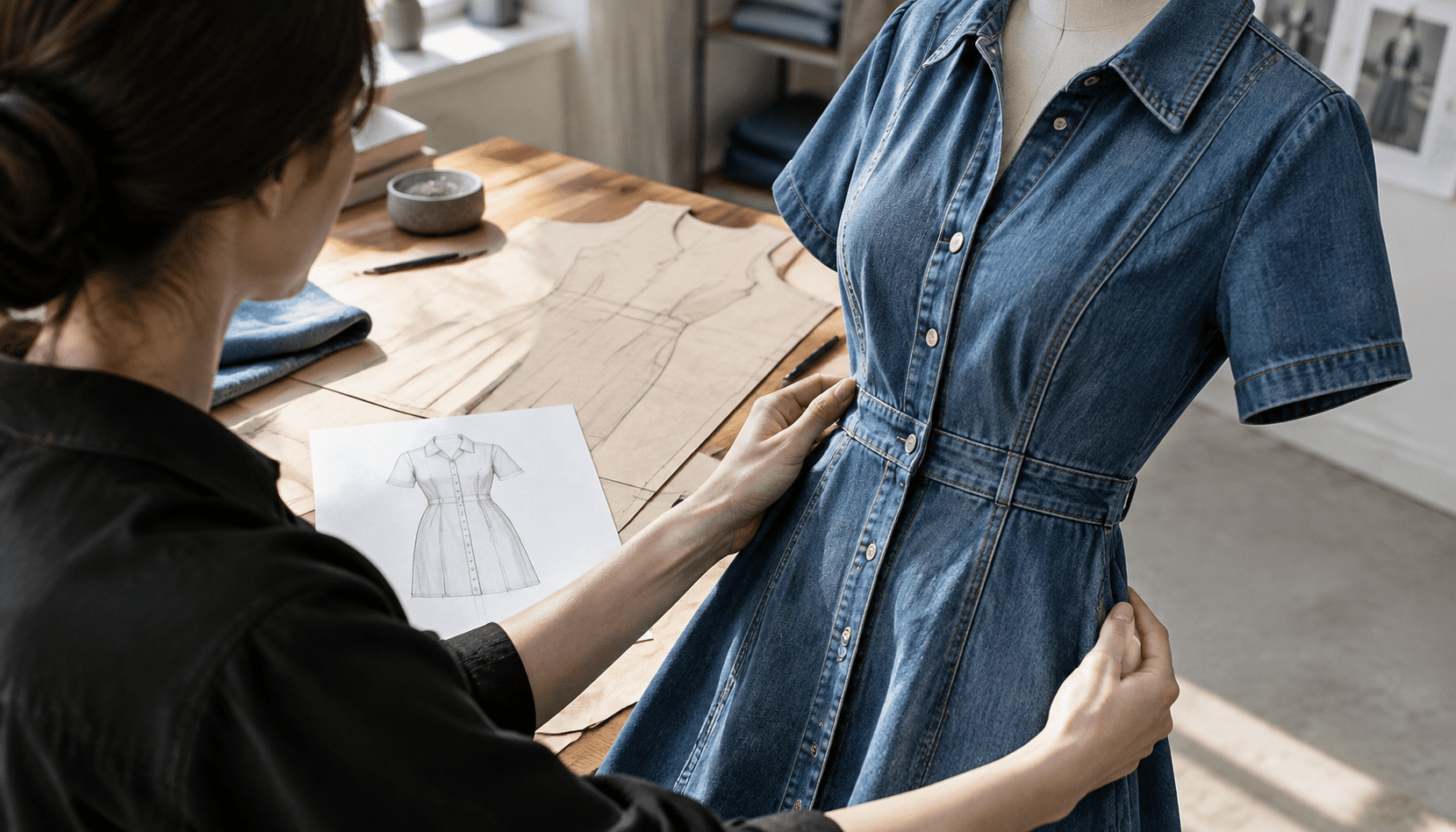
Denim dress sample development often gets stuck in one place: you take a reference style, feel it's "close enough," and go straight into sampling. But the reference style's specs are its own. Once your style changes any one of fabric, wash, fit, or trims, the sample needs to be re-confirmed under the new conditions.
First, distinguish between two paths. One is to follow the reference style's existing specs and only make minor adjustments to size or color; the other is to start from the reference style and adjust fit, fabric, or wash according to your own brand requirements. The confirmation workload and the materials you need to prepare differ between the two paths.
Fabric: Composition and weight can't be judged from images
A reference style's fabric composition, weight, and yarn structure can only come from confirmed product specs, fabric documentation, or sample records. You can't derive accurate composition and weight from looking at images or how a model wears it.
If your style needs stretch, you need to confirm stretch, recovery, and garment fit requirements at the same time. Non-stretch or structured styles also need to be discussed in terms of range of motion and size design. Once fabric is substituted, it may affect color, wash, hand feel, and garment dimensions. After a change, the sample should be re-checked and not simply treated as an equivalent replacement.
Wash: There's a gap between reference images and the actual garment
Customers can provide target color swatches, reference garments, or clear images to specify light/dark shades, whiskering, abrasion, distressing, fraying, or other treatment requirements. But reference images are affected by lighting and screens and cannot serve as an absolute color difference standard.
With different fabrics and constructions, the same wash process may produce different hand feel and color. When confirming samples, record key areas and details that need to be preserved. Don't communicate with "zero color difference" as the goal. When testing or special standards are needed, requirements and verification methods should be clearly specified during the development stage.
Fit and sizing: Provide size charts based on the target market
S, M, L labels in different markets cannot be directly treated as the same dimensions. You need to provide a size chart or key measurement points based on the target market, such as waist, hip, front and back rise, dress length, thigh circumference, etc. During sampling, verify measurement methods, size units, pre-wash or post-wash state, and allowable tolerances.
Bulk production uses the spec version confirmed by both parties. You can't infer the fit of all sizes from a model's body shape alone. Fit variations in denim dresses—such as high waist, straight cut, A-line, or cinched waist—directly affect these measurement points and need to be clarified before sampling.
Brand trims: Artwork and authorization go together
Brand details may include main labels, care labels, leather patches, buttons, rivets, zippers, hangtags, and packaging. You need to provide usable artwork, dimensions, colors, placement, and quantity requirements, and confirm pattern and trademark usage authorization.
Labeling information and material claims are based on confirmed documentation. Label content for different markets needs to be verified against specific requirements. Trims and packaging may have separate quantity, cost, and lead time requirements, which should be confirmed item by item during quoting. Don't assume everything is free or that any quantity can be customized.
How to choose between the two paths
| Conditions to confirm | Follow reference style specs | Adjust per brand requirements |
|---|---|---|
| Fabric | Verify existing spec documentation | Specify composition, weight, stretch requirements; re-confirm after substitution |
| Wash | Confirm the reference style's actual effect | Provide target color swatch or reference image; confirm through samples |
| Fit and sizing | Verify size chart and tolerances | Provide size chart per target market; confirm measurement methods |
| Brand trims | Confirm whether brand identity already exists | Provide artwork, authorization, and quantity requirements |
| Sampling arrangement | Arrange per existing specs | Confirm costs and rounds per adjustment plan |
Which path to choose depends on how much your style differs from the reference style. The more differences, the more steps need to be re-confirmed.
What to fill in first when materials are insufficient
If you currently only have a reference image, the most important things to clarify first are: target customer and wearing scenario, key measurement requirements, fabric hand feel direction (thickness, structured or soft), and the general direction of the wash effect. This information helps the business assess development feasibility better than a retouched image.
ZHIZHI's custom denim development and private label services support discussions starting from a reference style on adjustments to fit, fabric, wash, and brand details. The denim manufacturing process page covers the actual arrangements for sampling, sewing, washing, and other stages.
The next step in sample development is not to place an order directly, but to write out the four differences above item by item and form a requirements brief that can be quoted and sampled. The more specific the materials, the more controllable the sampling rounds.