
Denim bulk production and sample consistency: how packaging and shipping requirements affect acceptance
When discussing consistency between bulk denim production and samples, packaging and shipping conditions are often left until the end. This article compares the custom and available-styles paths, identifying at which stage packaging and shipping requirements should be confirmed, which items to check, and why a lack of records means consistency or inconsistency cannot be determined directly. Suitable for buyers and wholesalers currently arranging bulk acceptance or replenishment.
Bulk consistency is verified against the approved sample and confirmed specifications; packaging and shipping requirements must be itemized in the order, otherwise acceptance cannot be checked against them upon arrival.
In this article
First, distinguish: consistency checks and packaging/shipping checks are two separate mattersCustom vs. available styles: at which checkpoint are packaging and shipping requirements confirmed?Shipping checkpoints: dispatch, pickup, and arrival are not the same thingArrival inspection: use the same record to check both itemsWhen consistency or inconsistency cannot be directly determined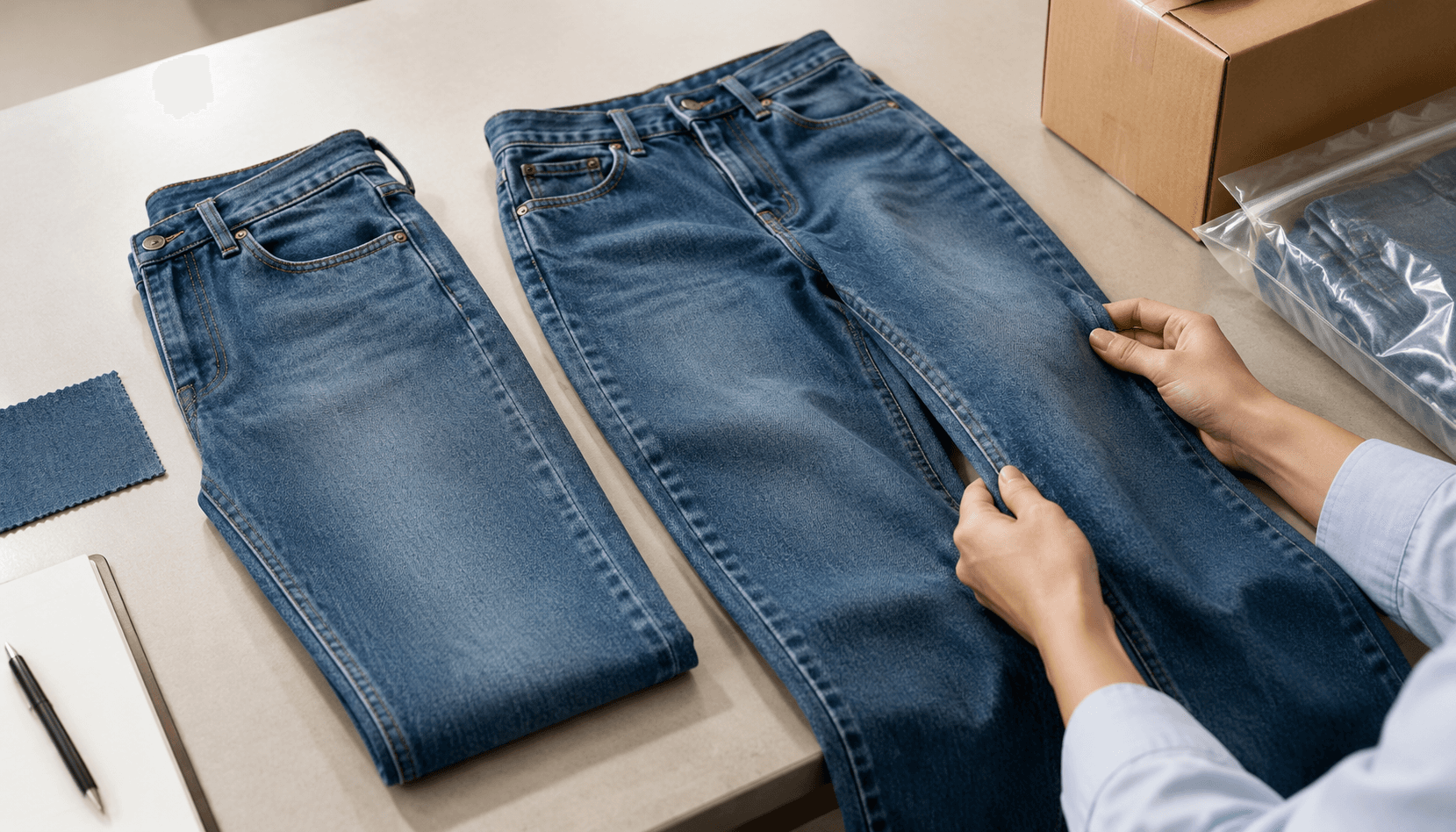
When packaging methods turn out to differ from what was agreed at the sample stage only after bulk goods arrive at the warehouse, the problem is often not that the garments themselves were made incorrectly, but that packaging and shipping requirements were not confirmed at the same checkpoint as the samples. For denim bulk production versus sample consistency, the reference points are the approved sample and the confirmed specifications; for denim garment packaging and shipping requirements, the reference points are the packaging method, labeling, and delivery conditions stated in the order. The two are related but cannot substitute for each other.
First, distinguish: consistency checks and packaging/shipping checks are two separate matters
Garment consistency looks at items such as fit, dimensions, wash color, stitching, and trim placement, based on the approved sample and the specification version confirmed by both parties. Packaging and shipping look at folding method, hanging or flat packing, polybag and carton specifications, label placement, packing ratio, shipping marks, and outer carton labeling. The former determines whether the garments are correct; the latter determines whether they can be counted and handed over as agreed upon arrival.
Mixing the two together easily leads to two types of misjudgment: packaging damage being treated as a garment quality issue; garment dimension deviations being overlooked because the packaging was intact. During inspection, records should be kept separately, and responsibility should be determined against the order terms.
Custom vs. available styles: at which checkpoint are packaging and shipping requirements confirmed?
Under the custom path, packaging, together with brand labels and trims, belongs to the solution confirmation stage. Main labels, care labels, hangtags, polybags, and outer carton markings should be confirmed item by item during the quotation and sampling stage; items involving separate quantities, costs, and lead times must be written into the quotation. Adding packaging changes after sample approval may affect scheduling and costs and requires re-verification.
Under the available-styles path, the packaging method is based on the information shown on the current product detail page and at the ordering window; if there are special packing or labeling requirements, whether they can be arranged should be confirmed with the sales team before placing an order, rather than assuming that available styles can be repackaged to brand requirements by default. If sizes are missing, quantities exceed the available range, or design changes are needed, you should likewise contact the sales team to confirm supply or move into custom discussions.
What both paths have in common: packaging and shipping requirements must be documented in the order or quotation confirmation; verbal agreements are not sufficient as a basis for acceptance upon arrival.
Shipping checkpoints: dispatch, pickup, and arrival are not the same thing
Provide the destination country, postal code, estimated quantity, and desired arrival date at quotation or order placement to facilitate logistics planning. Factory completion of shipment, carrier pickup, international transit, and customs clearance are different checkpoints. Communication about same-day dispatch for available styles or delivery of bulk goods within 30 days cannot be directly understood as same-day global arrival or guaranteed delivery within 30 days.
Freight, shipping method, taxes, customs clearance responsibility, and trade terms must be confirmed in the quotation or order; when unknown, do not assume DDP, tax-inclusive terms, or a particular carrier by default. After dispatch, follow up on logistics based on the information actually provided. If outer cartons are damaged in transit, first retain photos and receipt records, then judge against the packaging requirements in the order, rather than directly attributing it to garment quality.
Arrival inspection: use the same record to check both items
During inspection, it is recommended to put garment checks and packaging checks on the same record sheet: the garment section records style number, quantity, measurement results, and differences from the approved sample; the packaging section records outer carton condition, packing ratio, label placement, and whether shipping marks match the order. When deviations are found, collect the order number, style number, affected quantity, photos or videos, and measurement notes, then verify against the order and approved sample.
Custom orders and available-style orders may be subject to different terms; return/exchange conditions, costs, and responsibility are governed by the actual terms. The reply should state that the next step is for the sales team to verify and provide a proposed resolution, without promising refunds, restocking, compensation, or a fixed resolution timeline before verification.
When consistency or inconsistency cannot be directly determined
If the order does not specify the packaging method, packing ratio, or outer carton labeling, then upon arrival only the actual condition can be described, and whether it complies with the agreement cannot be determined. Similarly, if materials or construction were changed after sample approval but no version number or confirmation record was retained, garment consistency also lacks a comparable baseline.
If a specific inspection plan, third-party inspection, or test report is required, this should be raised in advance to confirm arrangements, costs, and responsibility; without documentation, do not promise a particular AQL level or pass rate. For specific items of packaging and shipping requirements, you can learn about the scope of discussion on the custom denim development and private label services page, or refer to the corresponding stage descriptions in the denim manufacturing process.
The judgment sequence can be summarized as: first confirm what is written in the order, then compare against the approved sample and packaging records, and finally distinguish garment issues, packaging issues, and shipping issues. Without any one of these written confirmations, the comparison lacks a basis.