
Custom Denim Shirt Fabric Selection and Garment Inspection Checklist: What to Align Before Custom Development
A sourcing guide for brands and buyers. Custom denim shirt fabric selection involves matching end use, hand feel, stretch, and wash direction; the garment quality inspection checklist requires clarifying size, appearance, color variation, stitching, and packaging checks before placing an order. Both decisions depend on confirmed specs and approved samples, not reference images or verbal descriptions.
Custom denim shirt fabric selection requires clarifying end use, stretch, and wash direction first, while garment inspection must use approved samples as the reference standard, recording size, color variation, and stitching results item by item.
In this article
Fabric Selection: Start with Use and Wearing ScenarioInspection Checklist: Use the Approved Sample as the Reference BaselineHow to Verify Dimensions and FitWhen to Confirm Brand Labels and TrimsWhat Basis Are Quotations and MOQs Based OnHow to Understand Sampling and Bulk Production Lead TimesHow to Choose Between the Two Sourcing PathsWhat Information to Prepare Before Inquiring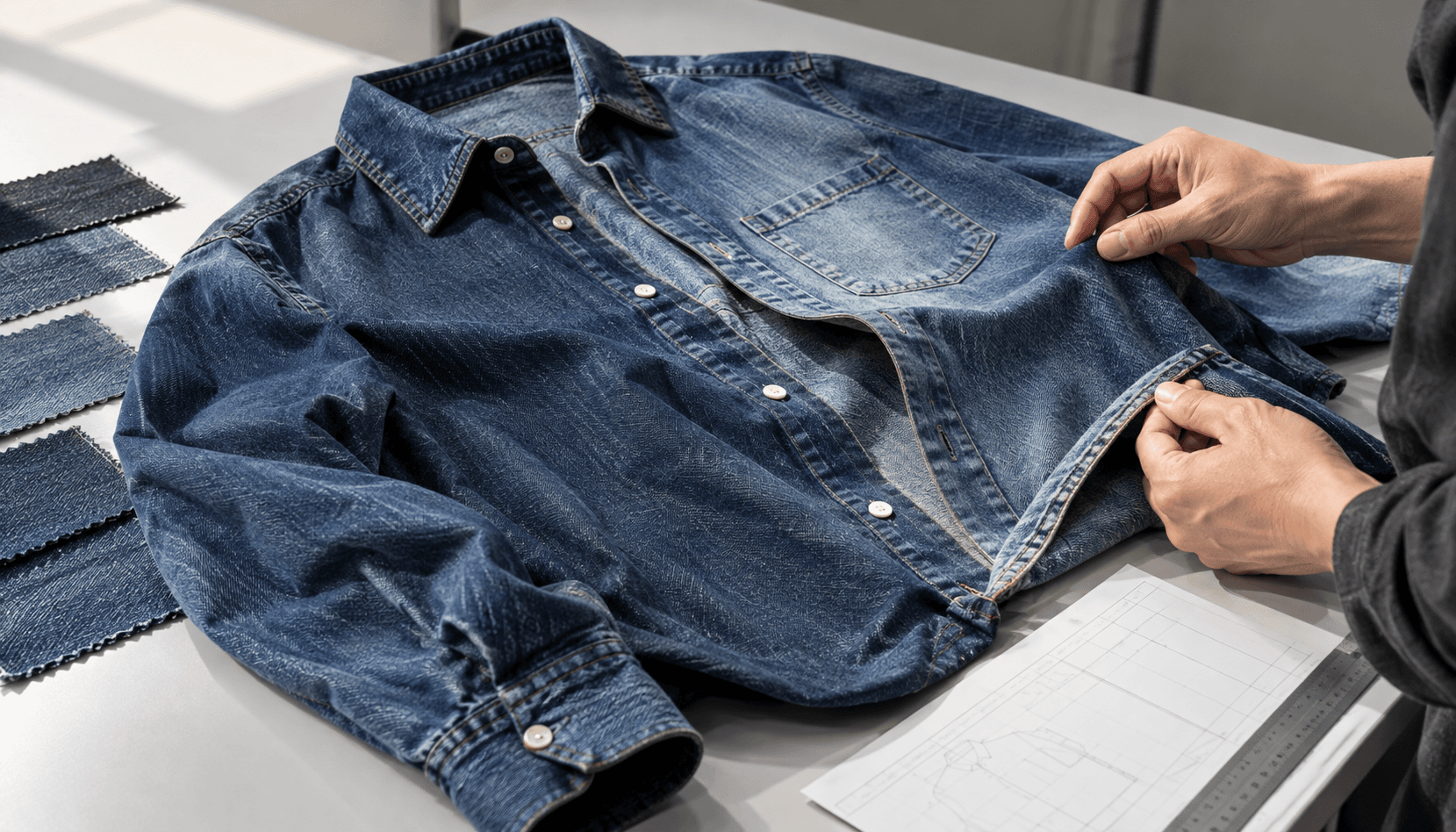
Choosing fabrics for custom denim shirts and the finished-garment quality inspection checklist address two different stages: the former determines the direction of the finished garment before sampling, while the latter verifies whether bulk production matches what was confirmed. Mixing the two often leads to fabrics being approved but wash effects not matching, or discovering at inspection that size standards were never aligned.
Fabric Selection: Start with Use and Wearing Scenario
When customizing denim shirts, fabric discussions can begin with use, season, hand feel, thickness, whether a crisp or soft hand is needed, and whether stretch is required. This information determines the direction of subsequent discussions, rather than starting with a fabric name.
For styles requiring stretch, stretch, recovery, and garment fit requirements should be confirmed at the same time. Non-stretch or crisp styles also need to be discussed in relation to movement allowance and size design. Fabric substitution may affect color, wash, hand feel, and garment dimensions; after any change, samples should be re-checked rather than treated as an equivalent replacement.
Accurate parameters such as composition, weight, yarn, and weave should come from confirmed product specifications, fabric data, or sample records — not from photo judgment. Customers can provide target color swatches, reference garments, or clear images indicating light/dark shades, whiskering, grinding, distressing, fraying, or other treatment requirements. Reference images are affected by lighting and screens and cannot serve as absolute color difference standards.
Different fabrics and structures may produce different hand feels and colors from the same treatment; effects should be confirmed through samples, with key areas and details to preserve recorded. Do not promise zero color difference, absolute colorfastness, or unverified eco-friendly processes. If testing or special standards are needed, requirements and verification methods should be specified during the development stage.
Inspection Checklist: Use the Approved Sample as the Reference Baseline
Before placing an order, inspection requirements for garment dimensions, appearance, color difference, stitching, trims, and packaging should be clarified, using the approved sample and confirmed specifications as the reference baseline.
If customers require a specific sampling plan, third-party inspection, or test reports, these should be raised in advance to confirm arrangements, costs, and responsibilities. Do not promise a specific AQL level, pass rate, or certification without supporting documentation. When deviations are found, record the style number, quantity, photos, and measurement results, and confirm the resolution with the business contact.
During sample review, it is recommended to consolidate feedback on fit, dimensions, fabric hand feel, color/wash, stitching, trims, and label placement in one round, annotating areas with photos and specifying target effects. Distinguish between must-change items and acceptable differences to avoid conflicting verbal feedback across multiple rounds. Keep version numbers and confirmation records for each revision; when materials or structure change, re-check costs and timelines as well.
Sample approval means both parties have established the production reference — it does not mean that details the customer has not confirmed can be decided by the factory. Sample fees, revision limits, and shipping arrangements are subject to project agreements.
How to Verify Dimensions and Fit
Customers should provide a size chart or key measurement points for the target market, such as waist, chest, shoulder width, body length, sleeve length, and cuff; S, M, L labels from different markets cannot be treated as identical sizes. During sampling, verify measurement methods, units, pre-wash or post-wash state, and tolerance allowances, and record fit feedback where necessary. Bulk production uses the specification version confirmed by both parties; wearing effects for all sizes cannot be inferred from a model's body alone.
Custom product galleries may include model front/back shots, flat-lay front/back shots, and detail images to help customers communicate style structure and design direction. Generated reference images do not prove that physical samples exist, that stock is available, that real customers exist, or that mass production capability is in place, nor can they be used to derive accurate composition and process parameters. When customers ask about final product effects, guide them to confirm samples, colors, dimensions, and process records; image displays cannot replace formal specifications and sample confirmation.
When to Confirm Brand Labels and Trims
Brand details may include main labels, care labels, leather patches, buttons, rivets, zippers, hang tags, and packaging. Customers should provide usable artwork, dimensions, colors, placement, and quantity requirements, and confirm pattern and trademark usage authorization. Labeling information and material declarations are subject to confirmed documentation; label content for different markets needs to be verified against specific requirements. Trims and packaging may have separate quantity, cost, and lead time requirements, which should be confirmed item by item at quotation. Before confirmation, do not promise that everything is free or that any quantity can be customized.
What Basis Are Quotations and MOQs Based On
Quotation discussions should account for style, quantity, fabric, wash, trims, brand customization, packaging, and delivery requirements. Range prices and tiered prices on available-style pages are not the lowest price applicable to any quantity; they should be verified against the combined quantity for the same style and current specifications. Custom products are quoted based on requirements and do not follow available-style pricing. When comparing quotes, customers should confirm whether sample fees, trims, packaging, shipping, taxes, and other services are included; without quotation confirmation, do not assume free shipping, tax-inclusive pricing, or free sampling.
Some custom development reference styles on the website indicate a MOQ of 30 pieces per style; MOQs for other custom styles still need to be confirmed per project. The 30-piece figure must not be treated as a universal commitment for all styles, fabrics, or colors. For available styles, the MOQ shown on the current detail page and ordering window applies; some items support a 1-piece minimum with mixed sizes for the same style. Verify whether MOQ rules are calculated by style, color, or size, and do not assume quantities from different styles can be combined by default. If customer quantities are low, discuss available-style trial sales or sample development first, then verify whether custom production can be arranged.
How to Understand Sampling and Bulk Production Lead Times
The person in charge states sampling takes 3 days, bulk production ships within 30 days depending on volume, and available styles ship the same day. Externally, it should be explained that these are capabilities and arrangements subject to confirmation based on the specific order, and cannot be guaranteed to apply unconditionally to all styles. Sampling requires verification of materials, fabrics, and processes; bulk production requires verification of volume and scheduling; available styles require verification of actual stock and dispatch conditions. The confirmation milestone from which lead time is counted must be written into the order. Shipping does not equal delivery; transit and customs clearance time are calculated separately.
Factory completion of shipment, carrier pickup, international transit, and customs clearance are distinct milestones. When requesting a quote or placing an order, provide the destination country, postal code, estimated quantity, and desired arrival date to facilitate logistics planning. Freight costs, shipping method, taxes, customs responsibilities, and trade terms must be confirmed in the quotation or order; when unknown, do not default to DDP, DDP tax-inclusive, or a specific carrier.
How to Choose Between the Two Sourcing Paths
When customers want quick replenishment or trial sales first, guide them to the available styles purchasing page /products to check sizes, quantities, stock, and shipping arrangements style by style. When customers want to change fit, fabric, wash, trims, or brand labels, guide them to the denim custom development and private label services page /denim/private-label to discuss custom solutions. Available-style pages should not mix in custom products; custom product displays show reference designs and do not indicate stocked inventory.
To determine the customer's path, ask first: are you purchasing existing styles, or do you need development based on your own brand requirements? Then ask about reference style numbers, quantities, and target lead times.
What Information to Prepare Before Inquiring
To reduce back-and-forth confirmation, a first inquiry should ideally include: reference style number or product link, design drawings or reference samples, target market and men's/women's positioning, estimated quantity per style, color and size breakdown, fabric or hand feel requirements, wash effects, brand label and packaging requirements, target lead time, and destination country. If information is incomplete, reference images can be sent first with a note on which details are most important to keep or adjust. Customer service should first confirm whether it is available styles or custom, then follow up on missing items that affect pricing; focus on two or three key questions at a time rather than blocking customers behind a lengthy questionnaire. The next step is to form a quotable requirements brief.
In the five stages of custom development, each stage should have a clear confirmation outcome, with the latest version synchronized after revisions to avoid inconsistencies between drawings, samples, and orders. The denim manufacturing process page /denim/manufacturing provides explanations of the corresponding stages.