
Denim bulk production and sample consistency: what can be verified from a flat-lay photo
In custom denim development, clients often use product images or flat-lay photos as the basis for bulk production acceptance, but images do not prove composition, weight, shrinkage, or color variation. Starting from what can and cannot be seen in a flat-lay photo, this article explains what verifiable information should be recorded when approving samples, and how to check bulk production against the approved sample—helping brands and buyers clarify the basis before sample sealing and inspection.
Flat-lay photos can only verify style silhouette and visible areas—not fabric composition, wash color variation, or dimensional tolerances; bulk consistency must be based on the approved sample and written specifications.
In this article
What flat-lay photos can verify: silhouette and placementKeep reviewable records when approving samplesBulk production is checked against the approved sample, not photosThe right role of images in communicationA practical review habit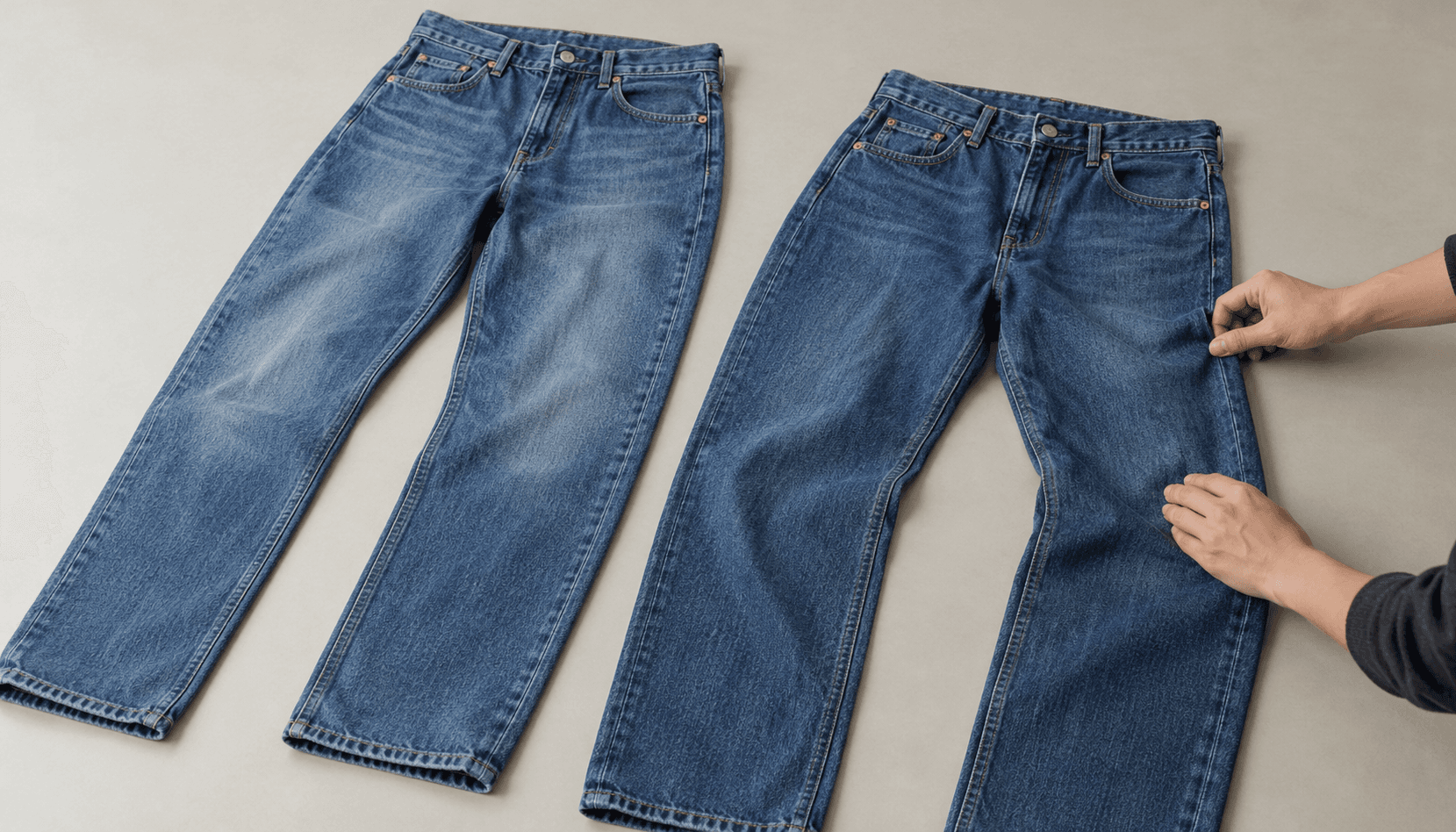
A flat-lay photo placed in front of you can show whether the leg shape is straight or slightly flared, the waistband height, pocket placement, and the general wash distribution. But treating it as the acceptance basis for consistency between bulk denim production and samples goes beyond what an image can carry.
What flat-lay photos can verify: silhouette and placement
Front and back flat-lay photos are suitable for communicating style structure: front and back panel proportions, fly direction, side seam placement, pocket shape, and whether flap pockets are present. These are visible pattern features, suitable for comparison with reference styles in early development.
However, flat-lay photos do not show fabric composition, weight, elastic recovery, or shrinkage after washing. A trouser leg that looks crisp in the same photo will feel different in the finished garment if the fabric weave or weight changes; the color depth from wash treatment may also differ across fabrics. These differences cannot be judged at the image stage.
Keep reviewable records when approving samples
Sample review should consolidate feedback on fit, measurements, fabric hand feel, color and wash, stitching, trims, and label placement in one pass, annotating areas on photos and stating the target effect. Distinguish between must-change items and acceptable variations to avoid conflicting verbal opinions across multiple rounds.
Measurement records should specify the measuring method, units, pre-wash or post-wash state, and allowed tolerances. For key areas such as waist, hip, front and back rise, inseam, thigh, and leg opening, writing only "suitable" cannot be reviewed at the bulk production stage. Keep version numbers and confirmation records for each round of changes; when materials or structure change, re-verify cost and timing accordingly. Sample approval means both parties have settled on the production reference—it does not mean details the customer has not confirmed can be decided by the factory on its own.
Bulk production is checked against the approved sample, not photos
Bulk production uses the specification version confirmed by both parties. When checking, compare finished garments side by side with the approved sample, rather than frame-by-frame against product images. Focus on whether measurements fall within recorded tolerances, whether wash color and local placement match the approved sample, and whether stitching and trims match the confirmation records.
When deviations are found, record the style number, quantity, photos, and measurement results, and confirm the handling plan with the business contact. Before placing an order, inspection requirements for garment measurements, appearance, color difference, stitching, trims, and packaging should be clearly defined. If the customer requires a specified sampling plan, third-party inspection, or test reports, these should be raised in advance to confirm arrangements, costs, and responsibilities; without documentation, do not promise a specific AQL level or pass rate.
For the three confirmation checkpoints on bulk-to-sample consistency, see Denim Bulk-to-Sample Consistency: Three Confirmation Checkpoints Wholesalers Most Often Overlook.
The right role of images in communication
The custom product gallery includes model front and back views, flat-lay front and back views, and detail shots, used to help communicate style structure and design direction. Generated reference images do not prove that a physical product exists, that stock is available, that real customers exist, or that mass production capability is in place, nor can they be used to derive accurate composition and process parameters.
When customers ask about the final finished effect, guide them toward confirming samples, colors, measurements, and process records. Image display cannot replace formal specifications and sample approval. If you wish to start from a reference style and discuss fit, fabric, wash, and brand details, you can follow the custom denim development and private label services path—first verifying fabric, wash, trims, and brand labels, then moving to sampling.
A practical review habit
After receiving a sample, take a set of photos under natural light at the same angles as the flat-lay images, along with measurement records and annotations of wash areas. At the bulk stage, compare using the same angles and lighting conditions—differences will be easier to spot. For differences that photos cannot clarify, do not rely on swapping in another screenshot to confirm.