
Mixed-Size Purchasing and Trim Labels: Two Customization Conditions That Are Easily Confused
For brands and wholesalers who often discuss mixed-size purchasing and trim label customization together in denim customization, this article explains, based on existing information, that the two are judged on different bases: mixed sizes depend on the combined total for the same style and the minimum order rules, while trims depend on confirmation samples and separate charges. Readers can use this to prepare materials separately and reduce repeated quoting.
Mixed-size purchasing checks minimum order rules based on the combined piece count for the same style, while trim labels require item-by-item confirmation of artwork, quantity, and charges; the two cannot substitute for each other.
In this article
Mixed-size purchasing: first clarify whether the minimum order quantity is calculated per style or per sizeTrims and brand labels: reference images are not confirmed piecesComparison of checkpoints for the two pathsPrepare the two types of information separately before quotingInformation boundaries and next steps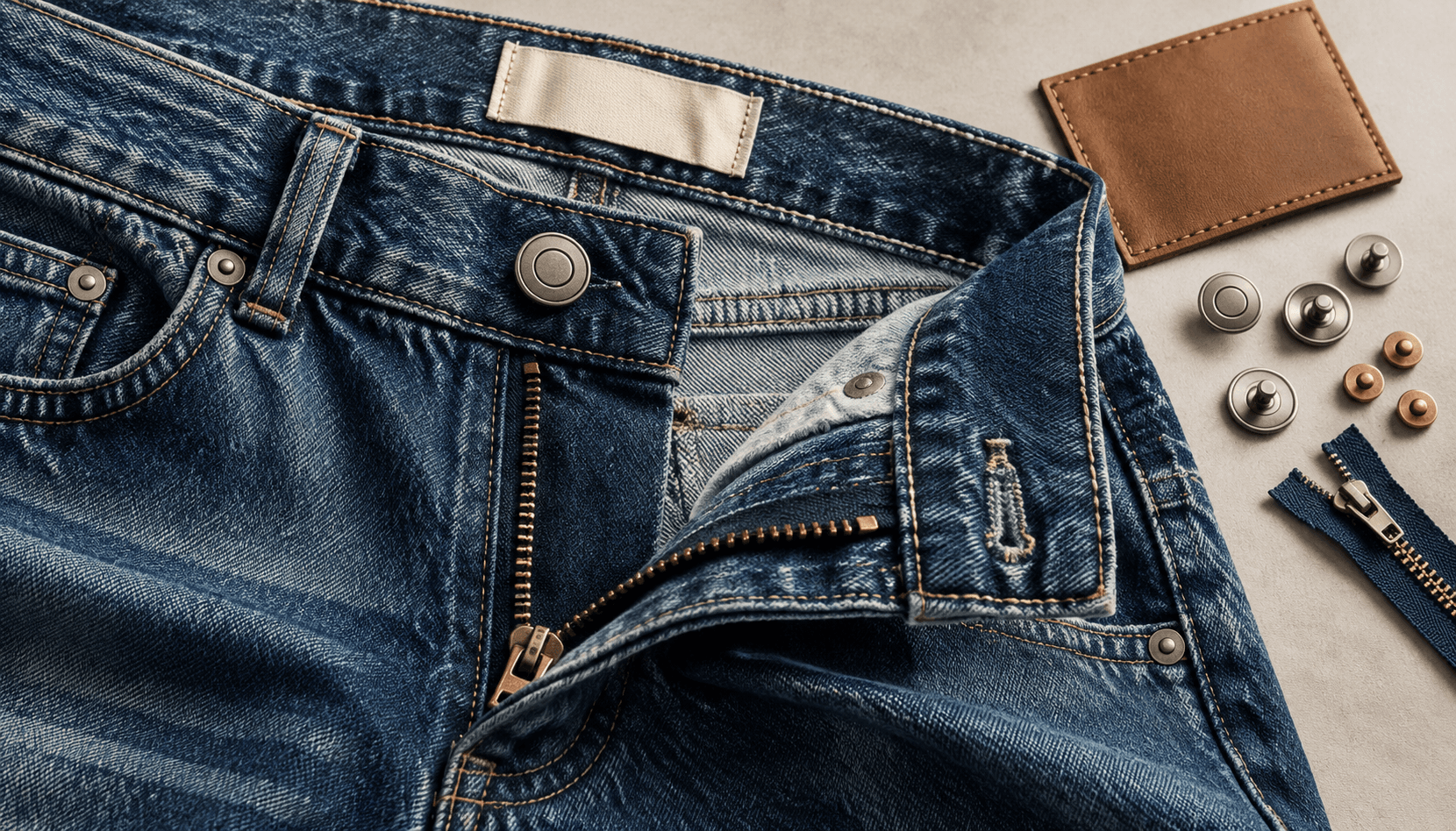
Questions about whether mixed-size orders are possible and whether trims and labels can be customized together often appear in the same inquiry. The two questions point to different confirmation steps: mixed-size purchasing requires checking what unit the minimum order rules are based on, while denim garment trims and brand label customization require item-by-item confirmation of artwork, quantities, costs, and lead times. Merging them into one question tends to lead to back-and-forth requests for missing information during quoting.
Mixed-size purchasing: first clarify whether the minimum order quantity is calculated per style or per size
Some custom development reference styles on the website indicate a minimum of 30 pieces per style, while minimum order quantities for other custom styles still need to be confirmed per project. This means 30 pieces cannot be treated as a uniform threshold for all styles, fabrics, or colors.
The key to mixed-size purchasing is checking the rules: whether the minimum order quantity is calculated per style, per color, or per size. Whether piece counts for different styles are combined by default also needs separate confirmation. For available styles, the minimum order quantity shown on the current product detail page and ordering window applies; some items support a minimum of 1 piece with mixed sizes within the same style.
For smaller quantities, you can first discuss available styles for test sales or sample development, then verify whether custom production can be arranged. Mixed sizing itself does not change the minimum order threshold; it simply means piece counts for different sizes of the same style are checked together.
Trims and brand labels: reference images are not confirmed pieces
Main labels, care labels, leather patches, buttons, rivets, zippers, hang tags, and packaging can all be discussed, but customers need to provide usable artwork, dimensions, colors, placement, and quantity requirements, and confirm authorization for the use of designs and trademarks.
Reference images indicate direction but cannot replace confirmed pieces. Label information and material claims are subject to confirmed documentation; label content for different markets needs to be checked against specific requirements. Trims and packaging may have separate quantity, cost, and lead time requirements, which should be confirmed item by item during quoting. Before confirmation, no commitment is made that everything is free of charge or that any quantity can be customized.
Comparison of checkpoints for the two paths
| Checkpoint | Mixed-size purchasing | Trims and brand label customization |
|---|---|---|
| Core basis | Total piece count per style and minimum order rules | Artwork, confirmed pieces, and authorization |
| Quantity basis | Per style, color, or size — to be confirmed | Separate quantities for each trim |
| Cost | Verified against current specifications and quantities | May be priced separately |
| Lead time | Confirmed in conjunction with production scheduling | May be independent of garment lead time |
| Common misunderstanding | Treating 30 pieces as a uniform threshold for all styles | Treating reference images as confirmed pieces |
Prepare the two types of information separately before quoting
To facilitate accurate quoting, please provide the reference style, estimated quantity, size breakdown, and destination country first. When brand labels are involved, attach artwork, dimensions, placement, and quantity requirements separately. When comparing quotes, customers should confirm whether sample fees, trims, packaging, shipping, taxes, and other services are included; unless confirmed in the quotation, free shipping, tax-inclusive pricing, or free sampling should not be assumed.
Custom products are quoted based on requirements and do not follow available-style pricing. The range prices and tiered prices on available-style pages are not the lowest prices applicable to any quantity; they should be verified against the total quantity per style and current specifications.
Information boundaries and next steps
The above minimum order quantities, trim costs, and lead times are all conditions that need to be confirmed for specific orders and are not uniform commitments for all styles, fabrics, or colors. Sampling in 3 days, delivery within 30 days for bulk orders depending on volume, and same-day shipping for available styles are capabilities and arrangements that need to be confirmed for specific orders; the confirmation point from which lead time is calculated still needs to be written into the order, and shipping does not equal arrival.
If only one action remains, first separate the mixed-size piece counts and the trims list into two pages of information, then proceed to quote discussions.