
Denim work pants pockets and craftsmanship: five boundaries to clarify before customization
A sourcing guide for brands and buyers: which aspects of pocket placement, construction, stitching, and wash effects on denim work pants can be discussed during the customization stage, and which must be confirmed through sample garments. The article explains each item according to the boundaries of available information, helping you articulate pocket craftsmanship clearly during inquiries and sampling to reduce discrepancies between bulk production and samples.
The craftsmanship boundaries of work pants pockets must be locked down with written specifications and sample garments before sampling—not relying on reference images or verbal descriptions; bulk production is verified against the approved sample garment.
In this article
Pocket position and dimensions: can be specified, but must be verified in the worn statePocket construction: process differences between flaps, patch pockets, and tool pocketsHow washing affects pockets: color and hand feel must be assessed togetherBulk production vs. sample consistency: use approved samples and confirmed specs as the verification basisHow to clearly communicate pocket requirements in an inquiry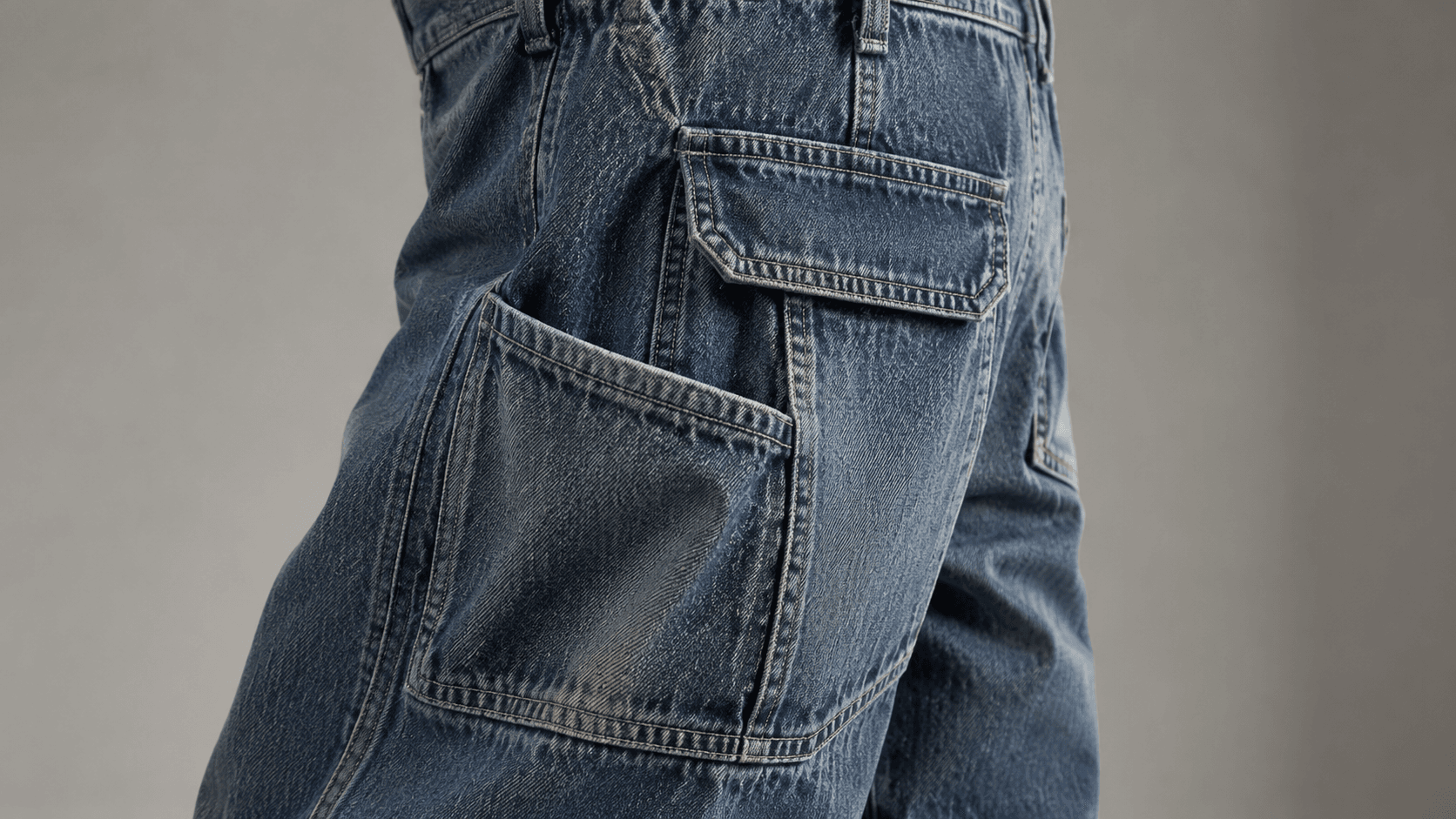
The pockets on denim work pants are not decorative details—they serve load-bearing functions, shape the garment structure, and create visual segmentation. When communicating about custom development, two things need to be distinguished first: which requirements can be discussed at the drawing and text stage, and which must be confirmed through sample garments.
Pocket position and dimensions: can be specified, but must be verified in the worn state
Work pants commonly feature side pockets, patch pockets, flap pockets, and tool pockets, and their position and dimensions change with waist height and leg width. Customers can provide reference styles or annotated drawings specifying how far the pocket opening is from the side seam, pocket depth, and flap width. However, position on a drawing does not equal position when worn—ease at the hip and thigh changes where pockets visually land. A more reliable approach: try on the sample garment in the target size, use a soft tape to measure the distance from pocket opening to side seam and from pocket bottom to hem, and record measurements before and after washing.
One thing to note: size labels from different markets cannot be directly converted. S, M, and L correspond to different waist and hip measurements, and pocket positions must be adjusted accordingly. If confirmation is based on only one size, other sizes may end up with pocket openings shifted too far forward or backward.
Pocket construction: process differences between flaps, patch pockets, and tool pockets
Flap pockets involve the flap, pocket bag, lining, and closure components; patch pockets mainly depend on edge finishing and stitching; tool pockets add an extra layer of segmentation and reinforcement. These constructions can be discussed during custom communication, but the sewing method, reinforcement approach, and trim pairing for each construction need to be confirmed on sample garments. For example, the curvature of a flap, the thickness of pocket fabric, and the position of rivets or bar tacks—images can only indicate the visual direction, not prove the actual sewing result.
If the customer requires pockets to bear weight or be used frequently, the usage scenario should be stated during sampling so the factory can confirm stitch density, pocket fabric material, and reinforcement points at the sample stage. These are process confirmations—not all styles share the same defaults.
How washing affects pockets: color and hand feel must be assessed together
Work pant pockets are often washed together with the body, but the pocket bag, flap, and body may have different shrinkage rates. The same wash treatment also produces different colors and hand feels on different fabrics. Customers can provide target color swatches or reference garments indicating whether pocket areas should retain dark tones, be abraded white, or distressed. Reference images are affected by lighting and screens and cannot serve as color difference acceptance criteria.
During sampling, it is recommended to compare pockets and body under the same light source and record dimensional changes before and after washing. If pockets require separate treatment, this should be raised at the proposal stage to confirm whether it affects the overall wash process and lead time.
Bulk production vs. sample consistency: use approved samples and confirmed specs as the verification basis
Batch consistency of pocket workmanship cannot be guaranteed by saying "same as the sample." Before placing an order, pocket type, dimensions, stitching, trims, and wash effects should be written into confirmed specifications, with the approved sample as the verification basis. During bulk production, deviations should be recorded by style number, body part, and measurement method. If pocket opening displacement or stitching inconsistency is found, first photograph, measure, and record quantities, then confirm the handling plan with the business contact.
If the customer requires a specified inspection plan or third-party inspection, this should be raised in advance to confirm arrangements, costs, and responsibilities. Without documentation, no AQL level or inspection pass rate can be promised.
How to clearly communicate pocket requirements in an inquiry
For a first inquiry, we recommend providing: reference style number or product link, annotated drawings of pocket position and type, target market, estimated quantity per style, size breakdown, fabric hand feel requirements, wash effects, brand labels and packaging requirements, target lead time, and destination country. If information is incomplete, send reference images first and describe the details you most want to keep or adjust. Our team will first confirm whether this is available stock sourcing or custom development, then follow up on missing items that affect pricing.
For available stock sourcing, pocket workmanship is based on the information shown on the current product page and ordering window; some items support mixed sizes, but stock and minimum order quantities need real-time verification. For custom development, you can refer to custom denim development and private label services to understand the scope of communication, or review the denim manufacturing process for corresponding production stages. For specific methods of verifying pocket workmanship against sample consistency, refer to Denim Bulk Production and Sample Consistency: Verification Boundaries for Work Pant Pocket Workmanship.
There is no universal template for confirming pocket workmanship—it depends on style construction, fabric, and wash plan. Being able to start a conversation does not mean a commitment can already be made. Writing boundaries into the documentation saves more time than arguing afterward.