Denim Garment Quality Acceptance Checklist: Where Are the Boundaries of Custom Denim Shorts Details
A sourcing guide for brands and buyers: how the denim garment quality acceptance checklist and custom denim shorts details work together. The article distinguishes between available styles and custom development paths, explains what the checklist can and cannot cover, and uses shorts' waistband, fly, leg opening, and wash placement as examples to identify which items must be confirmed at the sample stage and which can only be governed by order terms.
The acceptance checklist cannot replace sample confirmation; the waistband, fly, leg opening, and other parts of shorts must be verified against the approved sample and confirmed specifications; images and checklists serve only as communication tools.
In this article
What the checklist covers and what it doesn'tWhich custom details on shorts must be confirmed on the sampleAvailable styles vs. custom development: different ways to use the checklistWhat else to prepare beyond the checklist at acceptanceWhat to confirm at the current stage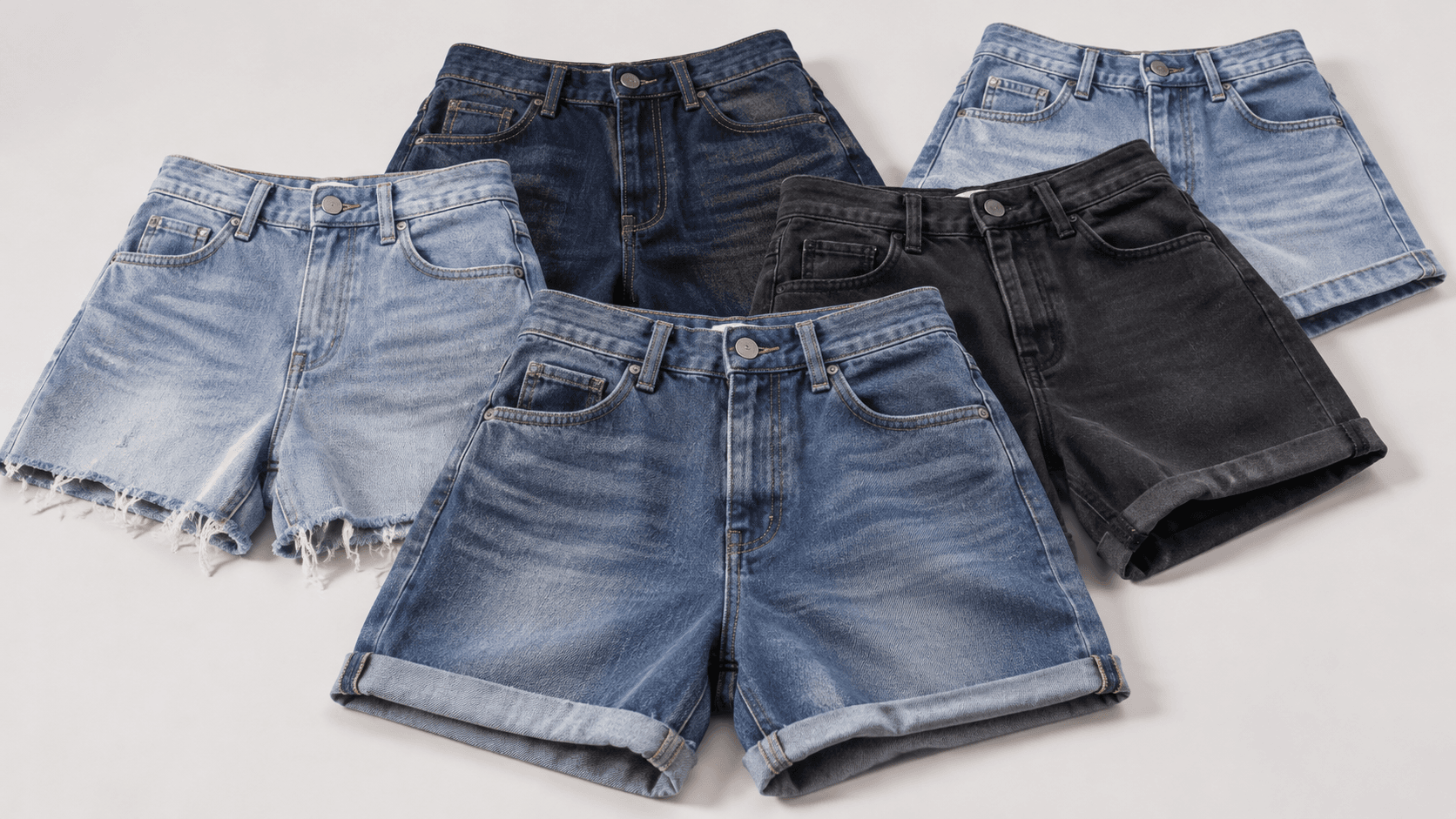
What the checklist covers and what it doesn't
A denim garment quality acceptance checklist is often treated as a universal ruler—as if ticking every box would guarantee bulk production. It doesn't work that way. A checklist is a verification tool, not a source of standards; it reminds you which areas to inspect, but it cannot decide what those areas should look like.
For buyers purchasing available styles, the checklist is used to cross-check the specifications and ordering window information currently shown on the product page—verifying sizes, quantities, and dispatch conditions. For buyers going through OEM / ODM customization, the checklist only makes sense when used alongside approved samples and confirmed specifications. Without a sample and a specification version, a "pass" on the checklist has no reference point.
Which custom details on shorts must be confirmed on the sample
Custom details for denim shorts concentrate in a few areas: waistband height and closure method, specification and position of the fly zipper or button, leg opening width and rolled-hem or raw-edge treatment, pocket position and depth, and wash placement. These items can only be roughly gauged from reference images—you cannot judge composition, stretch, or shrinkage from them.
Take the leg opening as an example. Rolled-hem width, number of stitching rows, and retained raw-edge length all need to be measured and recorded on the sample. The same applies to wash placement: where the whiskering starts, how far the abrasion extends toward the leg opening—reference images are affected by lighting and screens and cannot serve as an absolute color-difference standard. During sample review, it is advisable to consolidate feedback on fit, measurements, fabric hand feel, color and wash, stitching, trims, and label placement in one pass—annotating areas on photos and stating the target effect, distinguishing must-fix items from acceptable variations.
Available styles vs. custom development: different ways to use the checklist
The two sourcing paths rely on different verification bases, and mixing them up causes problems.
| Check item | Available style purchase | Custom development |
|---|---|---|
| Specification basis | Current product page and ordering window | Approved sample and confirmed specification version |
| Sizes and quantities | As shown in the current window | Per target-market size chart and order agreement |
| Wash and color | Cross-check against page display and actual delivery | Per the effect confirmed on the sample |
| Minimum order rules | Some styles support 1-piece minimum and mixed sizes within the same style | Some custom development reference styles indicate a 30-piece-per-style minimum; other styles confirmed per proposal |
| Lead time basis | Same-day dispatch for available styles requires checking actual stock and dispatch conditions | Sampling in 3 days; bulk delivery within 30 days depending on volume—both subject to confirmation per specific order |
The figures in the table reflect existing reference data and do not apply unconditionally to all styles. Whether minimum order quantities are calculated per style, per color, or per size must be verified item by item at quotation; quantities for different styles are not combined by default.
What else to prepare beyond the checklist at acceptance
Before placing an order, inspection requirements for garment measurements, appearance, color difference, stitching, trims, and packaging should be clearly defined. If the client requires a specified sampling plan, third-party inspection, or test reports, these should be raised in advance to confirm arrangements, costs, and responsibilities; without documentation, no specific AQL level or inspection pass rate is promised.
When deviations are found, record the style number, quantity, photos, and measurement results, and confirm the resolution with the business contact. This step is as important as the checklist itself: the checklist tells you what to inspect, the records tell you where the gap is.
For custom shorts acceptance, the measurement method, size unit, pre-wash or post-wash state, and allowable tolerances should also be established at the sample stage. Bulk production uses the specification version confirmed by both parties; the wearing effect across all sizes cannot be inferred solely from a model's body shape.
What to confirm at the current stage
If this round is custom shorts development, what needs to be completed next is not more checklist templates but the confirmation record for the shorts sample: target effects for waistband, fly, leg opening, pockets, and wash placement, together with corresponding measurement values and tolerances. The checklist can then be used to verify item by item against this record—the order cannot be reversed.
For available style purchasing, first verify the sizes and quantities in the current ordering window; if design modifications are needed, move to custom communication and proceed through the sample process.